
If you are planning a concrete project, you may be asking: how many square feet does one bag of concrete cover?
This is one of the most common questions for:
- Homeowners
- DIY builders
- Contractors
- Landscaping projects
The answer depends mainly on:
- Bag size
- Slab thickness
- Project type
A single bag of concrete can cover different square footage amounts depending on how thick the concrete is poured.
In this guide, you’ll learn concrete bag coverage formulas, coverage charts, practical examples, and tips for estimating concrete accurately.
Quick Answer: Concrete Bag Coverage
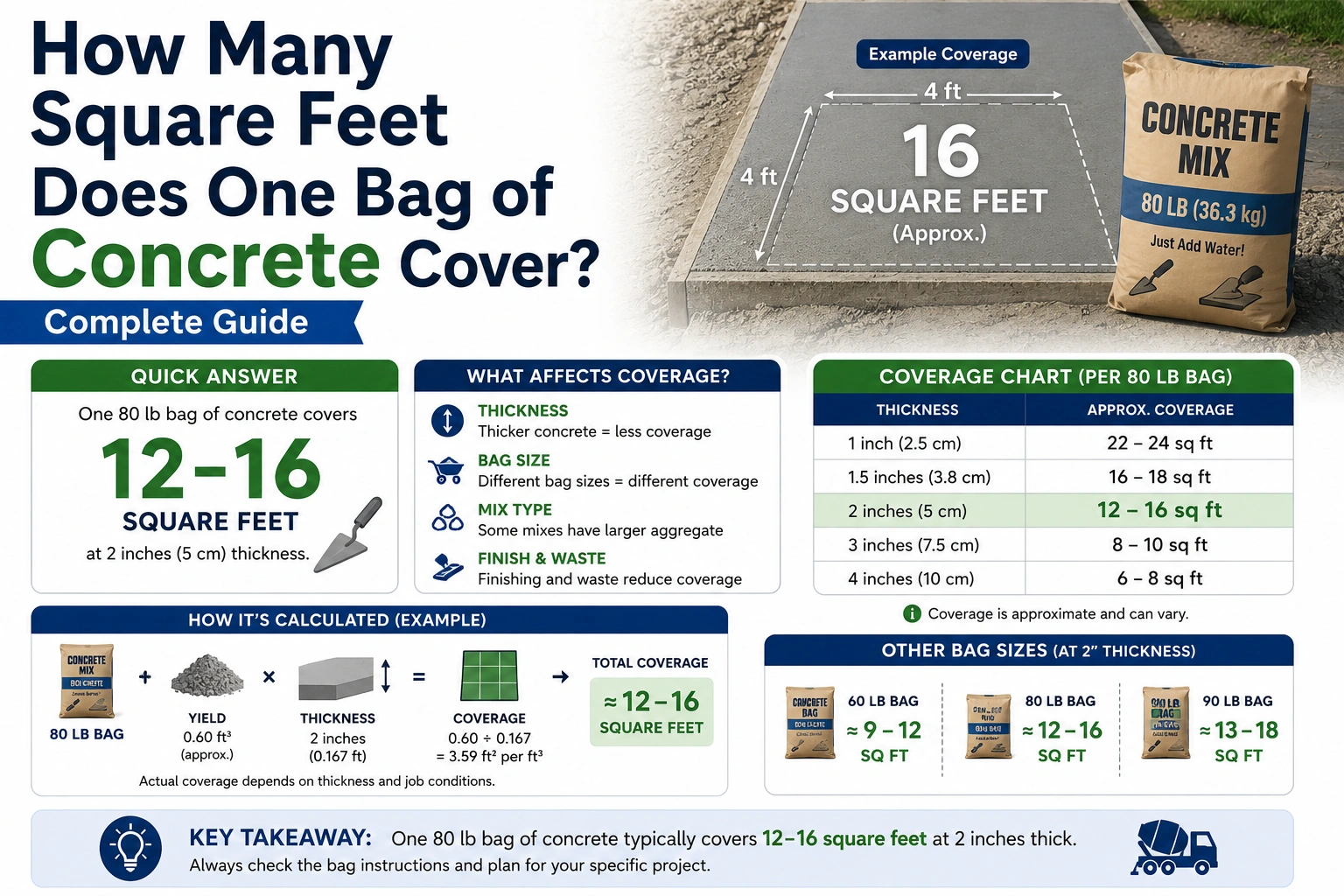
👉 An 80-pound bag of concrete typically covers:
- About 0.6 square feet at 12 inches thick
- About 1.8 square feet at 4 inches thick
- About 3.6 square feet at 2 inches thick
Coverage changes based on slab depth.
Why Concrete Coverage Changes
Concrete is measured by volume, not just area.
That means coverage depends on:
- Length
- Width
- Thickness
A thicker slab uses more concrete, reducing the total square footage covered.
Concrete Bag Sizes Explained
Concrete is commonly sold in:
- 40 lb bags
- 50 lb bags
- 60 lb bags
- 80 lb bags
Larger bags produce more concrete volume.
Average Concrete Yield by Bag Size
| Bag Size | Approximate Yield |
|---|---|
| 40 lb | 0.30 cubic ft |
| 50 lb | 0.37 cubic ft |
| 60 lb | 0.45 cubic ft |
| 80 lb | 0.60 cubic ft |
Concrete Coverage Formula
To estimate square footage coverage, use this formula:
Step-by-Step Example
Suppose you have:
- One 80 lb bag
- Yield = 0.6 cubic feet
- Slab thickness = 4 inches
Convert thickness to feet:
4 inches=124=0.333 feet
Now calculate coverage:
0.3330.6≈1.8 square feet
👉 One 80 lb bag covers about:
- 1.8 square feet at 4 inches thick
Coverage Chart by Thickness
80 lb Concrete Bag Coverage
| Thickness | Approximate Coverage |
|---|---|
| 2 inches | 3.6 sq ft |
| 3 inches | 2.4 sq ft |
| 4 inches | 1.8 sq ft |
| 6 inches | 1.2 sq ft |
Real-Life Concrete Examples
Small Sidewalk Repair
A patch measuring:
- 3 ft × 3 ft
- 4 inches thick
Area:
If one bag covers 1.8 sq ft:
1.89=5
👉 You need about:
- 5 bags of concrete
Patio Slab Example
A patio:
- 10 ft × 10 ft
Area:
At 4-inch thickness:
- Each bag covers 1.8 sq ft
Calculation:
1.8100≈56
👉 About 56 bags are needed.
Fence Post Example
Concrete for fence posts usually fills holes instead of flat slabs.
Coverage is measured differently because the shape is cylindrical.
Why Thickness Matters So Much
A thicker slab needs more volume.
For example:
- 2-inch slab → larger coverage area
- 6-inch slab → smaller coverage area
This is why project depth is critical when estimating concrete.
Common Concrete Thicknesses
| Project Type | Typical Thickness |
|---|---|
| Sidewalk | 4 inches |
| Patio | 4 inches |
| Driveway | 5–6 inches |
| Shed base | 4 inches |
How to Calculate Concrete Coverage
Step 1: Measure Area
Measure:
- Length
- Width
Multiply them.
Step 2: Determine Thickness
Convert inches into feet.
Example:
- 4 inches = 0.333 feet
Step 3: Calculate Volume Needed
Multiply:
- Area × Thickness
Step 4: Divide by Bag Yield
This tells you how many bags are needed.
Common Mistakes to Avoid
Ignoring Thickness
Thickness dramatically affects coverage.
Buying Too Few Bags
Always add extra concrete for:
- Waste
- Spillage
- Uneven surfaces
Mixing Inches and Feet Incorrectly
Convert all units carefully before calculating.
Tips for Accurate Concrete Estimates
Add Extra Material
Most contractors add:
👉 5–10% extra
Measure Twice
Incorrect measurements cause costly mistakes.
Use Larger Bags for Big Projects
80 lb bags reduce mixing time.
Plan for Waste
Concrete projects rarely use exact amounts.
Square Feet vs Cubic Feet
| Measurement | Purpose |
|---|---|
| Square Feet | Surface area |
| Cubic Feet | Volume |
Concrete calculations require both.
Concrete Coverage for Different Projects
Concrete bags are often used for:
- Small slabs
- Fence posts
- Walkways
- Patio repairs
- Steps and curbs
Larger projects usually order ready-mix concrete by the cubic yard.
Quick Rule to Remember
👉 Thicker concrete = less square footage coverage
This is the most important concrete estimating principle.
Why Accurate Estimates Save Money
Correct estimates help:
- Reduce waste
- Prevent project delays
- Avoid extra store trips
- Stay within budget
Practical Concrete Planning Tips
Before starting:
- Measure carefully
- Choose slab thickness
- Calculate extra material
- Prepare mixing tools in advance
Good planning makes concrete projects much smoother.
9. FAQs
1. How many square feet does one bag of concrete cover?
It depends on the bag size and slab thickness.
2. How much does an 80 lb bag cover at 4 inches thick?
About 1.8 square feet.
3. Why does thickness affect coverage?
Thicker slabs require more concrete volume.
4. Should I buy extra concrete bags?
Yes, adding 5–10% extra is recommended.
5. What size concrete bag is best?
80 lb bags are common for larger DIY projects.
10. Conclusion
So, how many square feet does one bag of concrete cover?
The answer depends mainly on:
- Bag size
- Slab thickness
- Project type
For example, an 80 lb concrete bag typically covers:
- About 1.8 square feet at 4 inches thick
The key rule to remember is:
👉 Thicker concrete slabs cover less area.
Using proper calculations helps you:
- Estimate concrete accurately
- Avoid running out of material
- Reduce waste and extra costs
- Plan DIY projects more efficiently
Before starting your project, always:
- Measure carefully
- Convert thickness correctly
- Add extra material for safety
With accurate planning and the right calculations, your concrete project will be much easier, faster, and more cost-effective.
Discover More Articles
How Many Feet Does a Crab Have? Complete Guide