
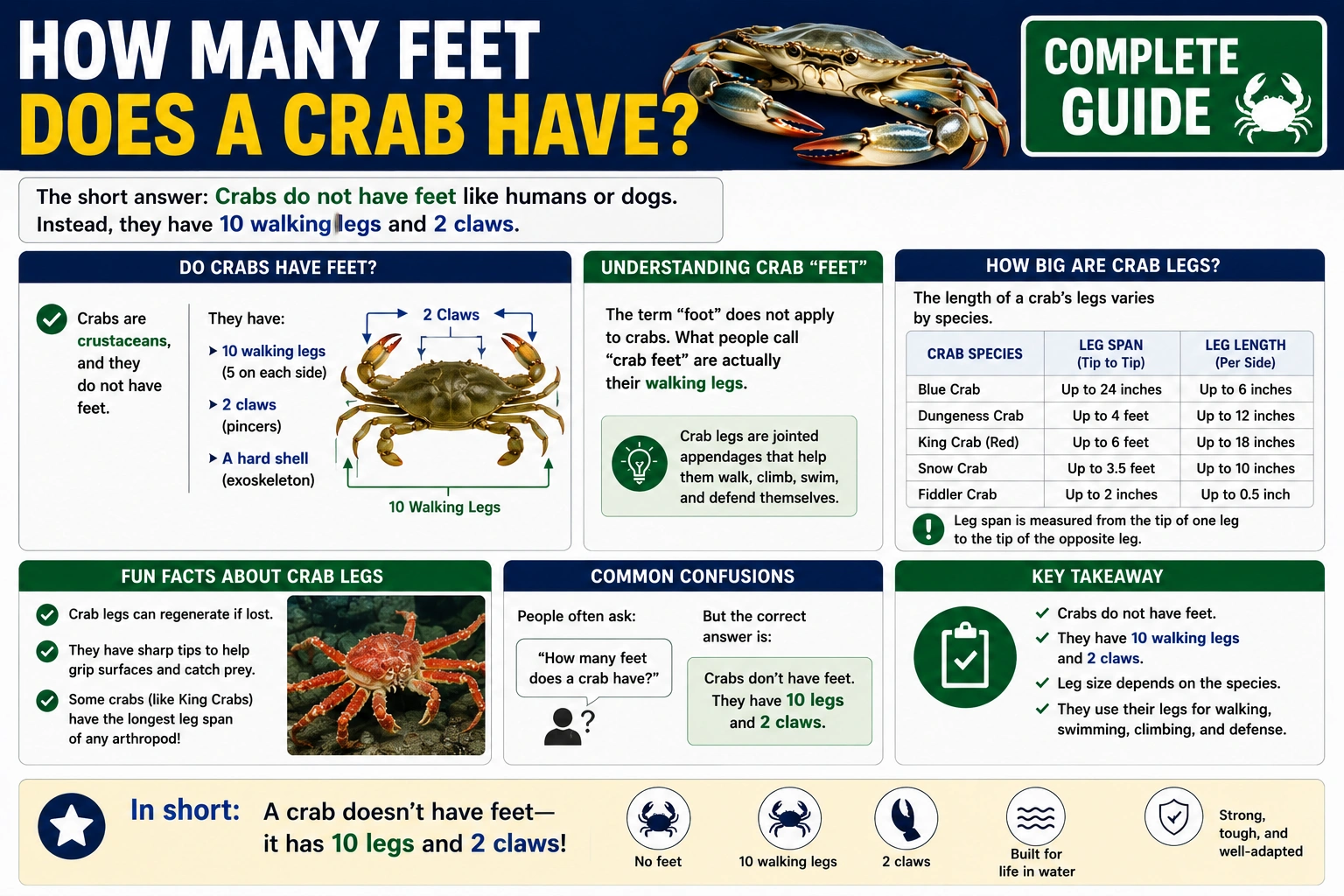
If you have ever watched a crab move across the sand or ocean floor, you may have wondered: how many feet does a crab have?
Crabs are fascinating sea creatures known for their hard shells, sideways walking style, and large claws. But many people get confused about how many feet or legs they actually have.
The simple answer is:
👉 Most crabs have 10 legs
However, not all of those legs are used the same way. Some are used for walking, while others are modified into claws.
In this guide, you’ll learn about crab anatomy, crab legs vs feet, how crabs move, and interesting facts about different crab species.
Quick Answer: Crab Feet Count
👉 Most crabs have 10 legs total
This includes:
- 8 walking legs
- 2 front claws (called pincers or chelae)
Crabs belong to a group of animals called decapods.
The word “decapod” means:
Deca=10
So decapod animals have:
👉 10 limbs
Are Crab Legs and Feet the Same Thing?
People often use the words:
- Feet
- Legs
Interchangeably when talking about crabs.
Technically:
- Crabs have legs
- The ends of the legs function like feet
So when someone asks:
👉 “How many feet does a crab have?”
They usually mean:
👉 “How many legs does a crab have?”
Understanding Crab Anatomy
Crabs have a unique body structure designed for movement, defense, and survival.
Their bodies include:
- Hard outer shell
- Eyes on stalks
- Claws
- Multiple walking legs
Walking Legs
Most crabs use:
👉 8 legs for walking
These legs help crabs:
- Move sideways
- Climb rocks
- Dig in sand
- Swim in some species
Front Claws (Pincers)
The first pair of legs are modified into claws.
These claws are used for:
- Catching food
- Protection
- Fighting
- Carrying objects
So although crabs have 10 legs total:
👉 Only 8 are mainly used for walking.
Why Crabs Have So Many Legs
Multiple legs help crabs survive in difficult environments.
Their legs improve:
- Stability
- Speed
- Balance
- Defense
Crabs often live on:
- Slippery rocks
- Sandy beaches
- Ocean floors
Extra legs help them move efficiently.
How Crabs Walk
One of the most interesting things about crabs is their sideways movement.
Unlike many animals, crabs usually walk:
👉 Side to side
Why Crabs Walk Sideways
Their leg joints bend outward, making sideways movement faster and easier.
This body design allows:
- Quick escape from predators
- Better balance
- Efficient movement on uneven surfaces
Different Types of Crabs
Although most crabs have 10 legs, species vary in size and appearance.
Blue Crab
The blue crab has:
- 10 legs
- Paddle-shaped swimming legs
Commonly found along Atlantic coasts.
King Crab
King crabs appear to have:
- 10 legs
But one pair is very small and hidden.
They are famous for:
- Large size
- Long legs
- Seafood popularity
Hermit Crab
Hermit crabs also belong to the decapod family.
They use:
- Shells for protection
And still have:
👉 10 limbs
Crab Legs vs Claws
| Body Part | Function |
|---|---|
| Walking Legs | Movement |
| Claws | Grabbing and defense |
The claws are technically modified legs.
Fun Facts About Crab Feet and Legs
Crabs Can Regrow Legs
If a crab loses a leg:
👉 It can often regrow it during molting.
Some Crabs Swim
Certain crab species use back legs like paddles.
Crabs Have Hard Exoskeletons
Their shells protect soft internal bodies.
Crabs Molt
As crabs grow, they shed old shells.
How Crabs Use Their Legs
Crab legs help with:
- Walking
- Climbing
- Swimming
- Digging
- Holding food
Each leg plays an important role.
Common Misunderstandings
Counting Claws Separately
Some people count only walking legs.
But claws are also legs.
Thinking Crabs Have Feet Like Mammals
Crab feet are part of their leg structure, not separate body parts.
Believing All Crabs Look the Same
Different species vary greatly in:
- Size
- Color
- Leg shape
Crab Classification
Crabs belong to:
- Arthropods
- Crustaceans
- Decapods
This classification explains their multiple legs and hard shells.
Why Crab Anatomy Is Important
Scientists study crab anatomy to understand:
- Marine ecosystems
- Animal evolution
- Adaptation and survival
Crabs play important roles in ocean food chains.
Crab Movement and Speed
Some crabs can move surprisingly fast.
Their multiple legs help them:
- Change direction quickly
- Escape danger
- Navigate rocky environments
Crabs in Nature
Crabs live in:
- Oceans
- Beaches
- Mangroves
- Rivers
- Coral reefs
Their leg structure helps them survive in all these habitats.
Quick Crab Fact to Remember
👉 Most crabs have:
- 10 total legs
- 8 walking legs
- 2 claws
Crab Legs in Seafood
Certain crab species are popular for:
- Snow crab legs
- King crab legs
These edible legs come from the crab’s walking limbs.
9. FAQs
1. How many feet does a crab have?
Most crabs have 10 legs total, including claws.
2. Do crab claws count as legs?
Yes, claws are modified front legs.
3. How many walking legs does a crab have?
Most crabs use 8 legs for walking.
4. Why do crabs walk sideways?
Their leg joints are designed for sideways movement.
5. Can crabs regrow lost legs?
Yes, many crabs can regrow legs during molting.
10. Conclusion
So, how many feet does a crab have?
👉 Most crabs have 10 total legs, including:
- 8 walking legs
- 2 front claws
Crabs are part of the decapod family, which means they naturally have ten limbs.
Their unique leg structure helps them:
- Walk sideways
- Climb surfaces
- Defend themselves
- Catch food
- Survive in marine environments
Although people often say “feet,” the correct biological term is usually “legs.” Still, both words commonly refer to the crab’s limbs in everyday conversation.
Crabs are fascinating animals with specialized body designs that make them excellent survivors in oceans, beaches, reefs, and coastal habitats around the world.
Whether you’re studying marine biology, helping a child learn animal facts, or simply satisfying your curiosity, understanding crab anatomy gives you a better appreciation for these unique and important sea creatures.
Discover More Articles
How Many Sq Feet Does a Quart of Paint Cover? Complete Guide
How Many Cubic Feet Is in a Yard of Concrete? Complete Guide