

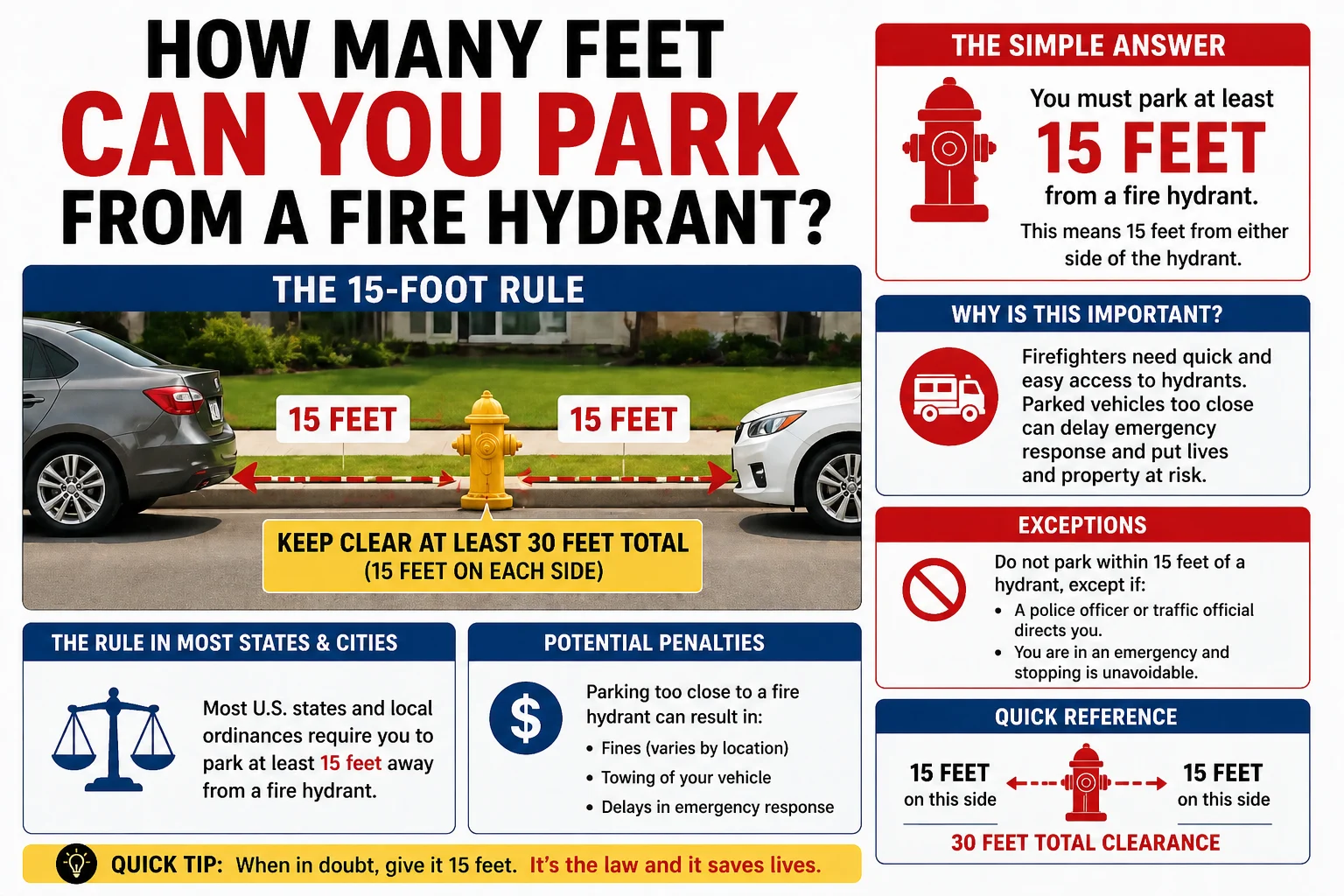
If you’ve ever wondered how many feet can you park within a fire hydrant, you’re not alone. This is one of the most important parking rules every driver should know.
Parking too close to a fire hydrant isn’t just illegal—it can also block emergency services when every second matters. That’s why strict distance rules exist in most places.
In this guide, you’ll learn the exact distance, why it matters, and how to avoid costly mistakes.
Quick Answer: Fire Hydrant Parking Distance
Let’s get straight to the point:
👉 You must park at least 15 feet away from a fire hydrant in most areas.
This is the standard rule in many countries, especially in the United States.
What Does This Mean?
- No part of your car should be within 15 feet
- The distance is measured from the hydrant
- Applies on both sides unless marked otherwise
Why You Must Keep Distance From a Fire Hydrant
This rule isn’t random—it’s based on safety and emergency needs.
Emergency Access
Firefighters need quick access to hydrants during fires. If a car blocks the hydrant:
- It delays response time
- It risks lives and property
Space for Equipment
Fire trucks need room to:
- Connect hoses
- Move around safely
- Operate efficiently
Even a few feet can make a big difference.
Fire Hydrant Parking Distance by Location
While 15 feet is common, rules can vary slightly.
United States
- Standard: 15 feet
- Strict enforcement in cities
- Markings may be painted red
Canada
- Usually 3–5 meters (about 10–16 feet)
- Similar enforcement rules
United Kingdom
- No fixed universal distance
- Parking must not block access
Other Regions
- Local laws apply
- Always check road signs
What Does 15 Feet Look Like?
Many drivers struggle to estimate distance.
Real-Life Comparison
- About the length of a large SUV
- Roughly 4–5 big steps
- Half the length of a small bus
Easy Estimation Trick
- One car length ≈ 14–16 feet
👉 So just stay at least one full car length away
Penalties for Parking Too Close to a Fire Hydrant
Ignoring this rule can be expensive.
Fines
- Can range from $50 to $200+
- Higher in busy cities
Towing
- Your car may be towed immediately
- Extra charges apply
Damage Risk
In emergencies, firefighters may:
- Break windows
- Run hoses through your car
Yes, this actually happens.
How to Measure Distance Correctly
You don’t need a tape measure—just use simple tricks.
Use Your Steps
- One step ≈ 2.5–3 feet
- Take 5 steps away from hydrant
Use Your Car Length
- Most cars ≈ 14–16 feet
- Stay at least one full car away
Common Mistakes Drivers Make
Even experienced drivers get this wrong.
Parking “Just a Little Close”
Even 1–2 feet too close can result in a fine.
Ignoring Markings
Red curbs often indicate no parking zones.
Blocking Without Realizing
Large vehicles may extend into restricted space.
Expert Tips to Avoid Tickets
Want to stay safe and legal? Follow these tips:
Always Leave Extra Space
Don’t aim for exactly 15 feet—leave more.
Look for Road Markings
- Red paint
- Signs
- Curb markings
Avoid Tight Spots
If unsure, find another parking space.
Real-Life Parking Scenarios
Here are practical situations to help you understand better:
Parking Near a Hydrant on a Busy Street
Leave more than 15 feet because traffic conditions can make space tighter.
Parking at Night
It’s harder to judge distance—give extra room.
Parking in Residential Areas
Rules still apply even if the street is empty.
9. FAQs
1. How many feet can you park within a fire hydrant?
You cannot park within 15 feet of a fire hydrant in most areas.
2. Can I stop briefly near a hydrant?
In many places, even temporary stopping is not allowed.
3. How do I know the correct distance?
Use one car length or about 5 steps as a guide.
4. What happens if I block a hydrant?
You may get fined, towed, or your car could be damaged in emergencies.
5. Are rules the same everywhere?
No, but 15 feet is the most common standard.
10. Conclusion
Understanding how many feet can you park within a fire hydrant is essential for every driver. The general rule is simple:
👉 Stay at least 15 feet away
This small distance can make a huge difference in emergencies. It helps firefighters do their job quickly and keeps you safe from fines and penalties.
When in doubt, always leave extra space. It’s better to walk a few more steps than deal with a ticket—or worse.
Follow the rule, stay aware, and park responsibly.