
If you’re preparing for your driving exam, one question probably comes to mind: how many feet is the parallel parking test?
This is one of the most important parts of the driving test—and also one of the most stressful. The good news is that once you understand the exact measurements and how the space is designed, parallel parking becomes much easier to manage.
In this complete guide, you’ll learn the standard dimensions, variations by region, and practical tips to help you pass your test confidently.
Understanding Parallel Parking Test Measurements
Parallel parking is designed to simulate a real-world scenario—parking your car between two vehicles along a curb. To make the test fair and consistent, examiners use specific measurements.
Why Measurement Matters
The distance determines how much room you have to maneuver. Too small, and it becomes unrealistic. Too large, and it doesn’t properly test your skills.
That’s why most driving authorities follow a standardized range.
General Standard Size
In most cases, the parking space is slightly longer than a typical car. This allows room for safe maneuvering while still testing precision.
How Many Feet Is the Parallel Parking Test in Most States
So, let’s answer the main question clearly:
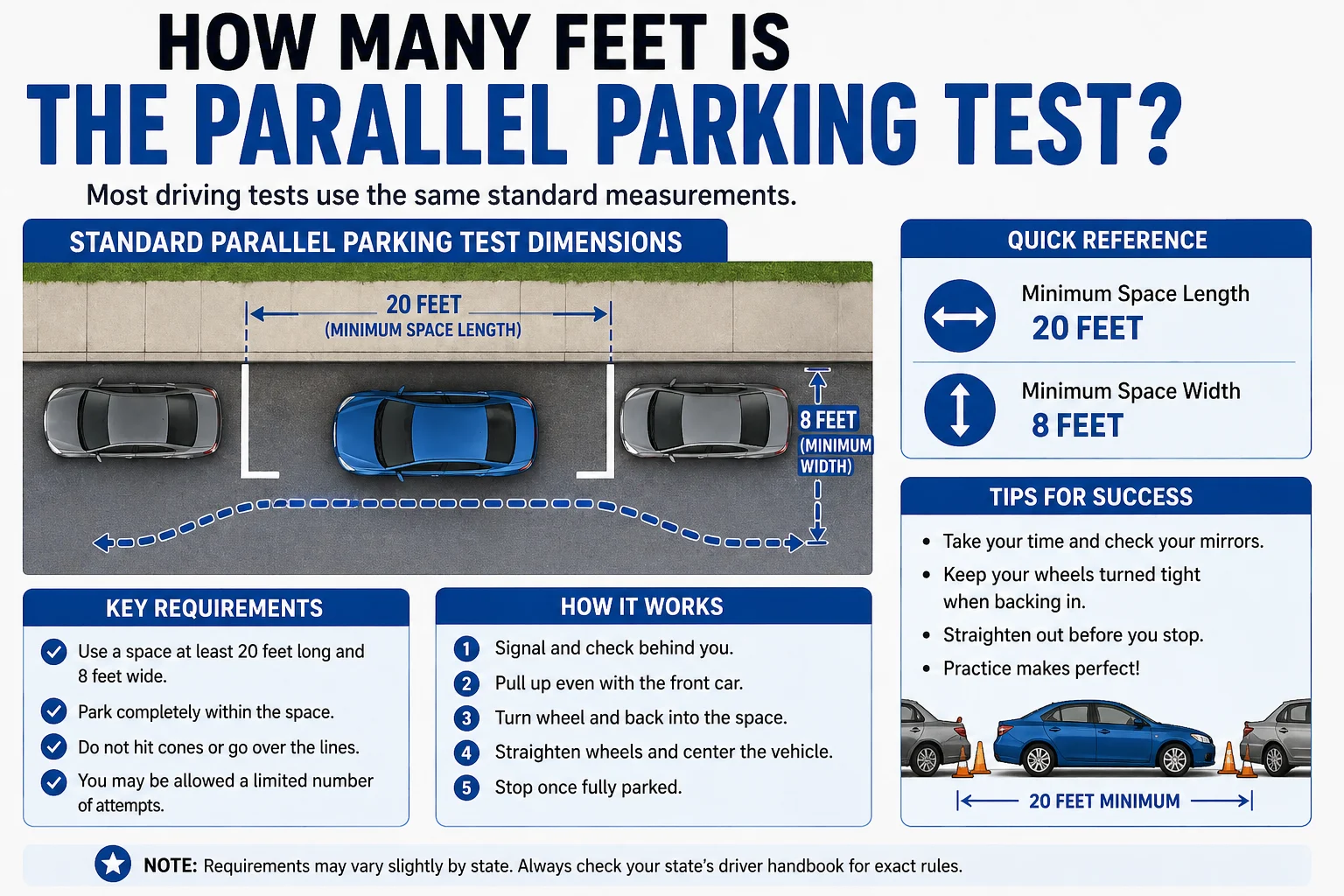
👉 The parallel parking test space is usually between 22 and 26 feet long.
This range is considered standard across many driving authorities.
Typical Dimensions
- Length: 22–26 feet
- Width: 7–10 feet
- Buffer space: A few feet in front and back
This means the parking space is typically about 1.5 times the length of a standard car.
Why This Range?
- Smaller cars need less space
- Larger vehicles need more room
- The test must suit all drivers
Parallel Parking Test Dimensions by Region
Although the general range stays similar, the exact measurements can vary slightly depending on where you take your test.
United States
Most states follow this structure:
- 24 feet long (average)
- Cones or poles marking boundaries
- Curb alignment required
United Kingdom
- No fixed measurement in all cases
- Often done between real cars
- Focus is more on control than exact distance
Canada
- Similar to the U.S.
- Usually around 22–25 feet
- Strict rules on distance from curb
Other Countries
- May use real street conditions instead of cones
- Space may vary depending on testing area
Standard Parallel Parking Space Breakdown
Here’s a simple comparison table to help you visualize the space:
| Component | Measurement (Feet) |
|---|---|
| Total Length | 22–26 ft |
| Width | 7–10 ft |
| Distance Between Cones | 20–25 ft |
| Distance from Curb | 6–12 inches |
This table shows that while there’s a standard range, slight differences are normal.
How to Judge Distance During the Test
Knowing the measurements is helpful—but judging them in real time is what really matters.
Visual Cues
Use these simple tricks:
- Align your rear bumper with the front cone
- Use the side mirror to track curb distance
- Watch your rear window for alignment
Mirror Techniques
- Keep checking both side mirrors
- Use your rearview mirror for depth
- Adjust mirrors before starting
These small habits make a big difference during the test.
Step-by-Step Parallel Parking Method
Now let’s break down how to actually park within that 22–26 feet space.
1. Position Your Car
- Stop next to the front cone
- Keep about 2–3 feet distance
- Align your car evenly
2. Start Reversing
- Turn the steering wheel fully toward the curb
- Move slowly
3. Straighten the Wheel
- Once your car enters at a 45-degree angle
- Straighten the steering
4. Turn Opposite Direction
- Turn wheel away from curb
- Continue reversing
5. Adjust Position
- Center your car
- Stay within the space
- Keep proper curb distance
Common Mistakes in Parallel Parking Tests
Even if you know how many feet is the parallel parking test, mistakes can still happen.
Misjudging Distance
- Turning too early or too late
- Not using reference points
Hitting the Curb
- Turning too sharply
- Not straightening in time
Going Outside the Lines
- Poor alignment
- Rushing the process
Lack of Control
- Moving too fast
- Oversteering
Expert Tips to Pass the Test Easily
Want to increase your chances of passing? Follow these proven tips.
Practice With Cones
Set up your own practice space:
- Use 22–26 feet distance
- Practice daily
Use a Consistent Method
Stick to one technique. Don’t switch styles often.
Go Slow
Speed is your enemy here. Slow movements give better control.
Know Your Car Size
Understanding your vehicle length helps you judge space better.
Adjust Mirrors Properly
This alone can improve your accuracy dramatically.
Real-Life Example of Parking Space Size
Imagine your car is about 15 feet long.
Now compare:
- Parking space: 24 feet
- Extra space: 9 feet
That extra space is divided between the front and back, giving you room to adjust.
But remember—this space disappears quickly if you make incorrect turns.
Why Parallel Parking Distance Feels Difficult
Even though the space is designed to be fair, many drivers struggle.
Here’s why:
- Limited visibility
- Fear of hitting obstacles
- Lack of practice
- Poor depth judgment
The key is repetition. The more you practice within the correct distance, the more natural it becomes.
Practice Recommendations
If you’re serious about passing, follow this plan:
Daily Practice Routine
- 20–30 minutes per day
- Use cones or markers
- Simulate real test conditions
Practice in Different Areas
- Empty parking lots
- Quiet streets
- Marked spaces
Measure Your Practice Space
Always stick to the 22–26 feet rule so your practice matches the test.
9. FAQs
1. How many feet is the parallel parking test exactly?
Most parallel parking test spaces are between 22 and 26 feet long, depending on location.
2. How far should I be from the curb?
You should be within 6–12 inches from the curb.
3. Is the test harder with cones or real cars?
Cones are easier because they’re more forgiving than real vehicles.
4. Can I adjust during the parking test?
Yes, most tests allow minor adjustments as long as you stay within limits.
5. What happens if I hit the curb?
In many tests, hitting the curb can result in point deductions or failure.
10. Conclusion
Understanding how many feet is the parallel parking test gives you a major advantage before your driving exam. With a typical range of 22 to 26 feet, the space is designed to challenge your control—not trick you.
The key to success is simple:
- Practice with accurate measurements
- Use consistent techniques
- Stay calm and move slowly
Once you get comfortable judging distance and controlling your car, parallel parking becomes much less intimidating—and much more predictable.
Master the space, trust your method, and you’ll pass with confidence.
Discover More Articles
29 Inches Is How Many Feet? Complete Guide
How Many Feet Equal 33 Inches? Complete Guide
How Many Square Feet Does One Pack of Shingles Cover? Complete Guide